
Local SEO for Therapists in Canada: The Complete 2026 Guide
1/6/202619 min read


If you're a Canadian therapist who is struggling to have new clients despite having a beautiful website and professional credentials, you are not alone.
The problem is not your qualifications, it's your local search visibility. When potential clients in your city search terms like "therapist near me" or "anxiety therapist [city]" on Google, you are nowhere to be found.
I have spent almost 2 years deep in SEO research, testing strategies on my own projects, and analyzing what actually works for therapists from case studies from Reddit, Quora, and practitioner forums.
I am sharing in this post exactly what works. This guide covers everything Canadian therapists need to know about Local SEO in 2026, including province-specific compliance requirements, the fastest ranking tactics, and ethical review strategies that actually work.
Table of Contents
What is Local SEO for Therapists?
Why Local SEO Matters for Canadian Therapists in 2026
The #1 Local SEO Mistake Canadian Therapists Make
Canada-Specific Local SEO Challenges
What Canadian Therapy Clients Search For
The 5 Core Components of Therapist Local SEO
Which Directories Actually Matter for Canadian Therapists
Content Strategy That Converts Therapy Clients
30-Day Quick Win Action Plan
Frequently Asked Questions
What Is Local SEO for Therapists?
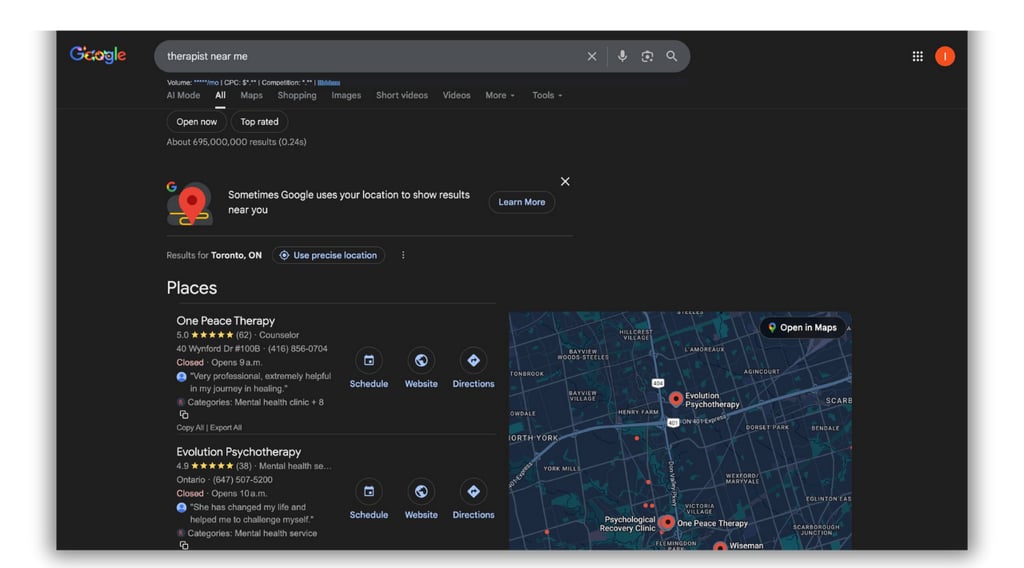
By definition, Local SEO(Search Engine Optimization) means the process of optimizing your online presence(it can be your Google business profile, website, or social media) to appear in local search results when potential clients in your area search for therapy services.
But if we say in simple words, Local SEO means helping your therapy practice show up online when people in your city or nearby area search for therapy services or your particular service.
For therapists, the goal is to appear in places like:
The top 3 listings on Google Maps
No 1 or top 3 in Searches like “therapist near me”, “counsellor near me”, or any keyword related to your practice[area,near me].
City-based searches such as “anxiety therapist Toronto” or “trauma therapy Vancouver.”
Google Maps, when someone looks for therapists close to them
Local SEO is different from regular SEO. The goal of regular SEO is to reach people across the whole country/world.
Local SEO focuses only on your city or area, so you attract people who can actually book sessions with you.
Why Therapists Need Local SEO in 2026
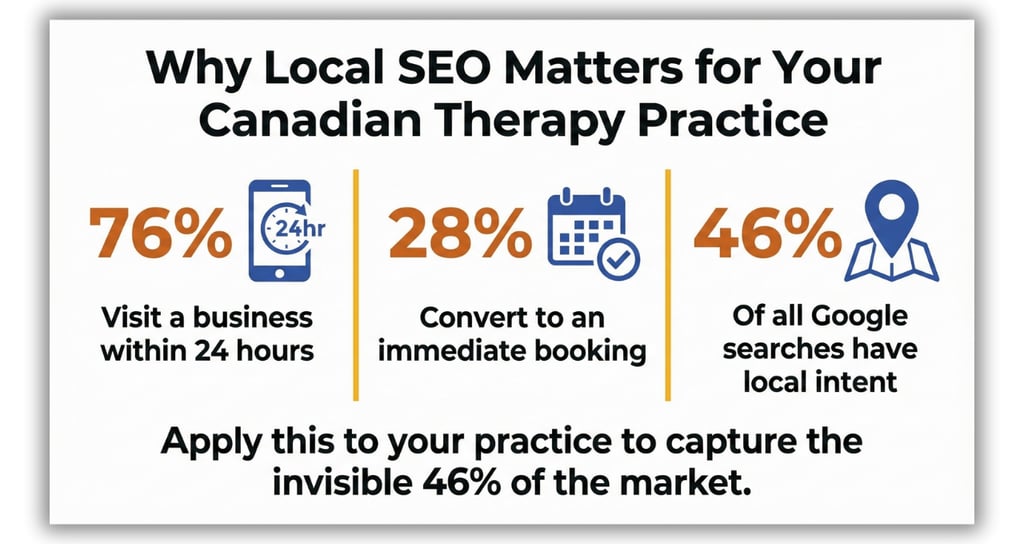
The 24-Hour Rule: 76% of people who search for a local service on their smartphone visit a business within 24 hours.
High Intent: 28% of those local searches result in an immediate "purchase" (in your world, that’s a booking).
The Volume: 46% of all Google searches now have "local intent." If you aren't showing up in that local "Map Pack," you are invisible to nearly half the market.
For Canadian therapists specifically
When it comes to Psychology Today, you pay $34.95 CAD/month (+ tax) just to list your name. With directory saturation at an all-time high in cities like Toronto and Vancouver, your profile is buried under hundreds of others unless you constantly tweak it. You are renting visibility, not owning it.
BetterHelp and large corporate therapy networks dominate paid ads, with BetterHelp spending over $100 million/year on advertising. They dominate the top spots for keywords like "anxiety therapist," driving the price up for everyone else.
In 2025, the average "Cost Per Click" (CPC) for health services in Canada hit $3.50–$5.00+ CAD. To get enough clicks to actually fill your caseload, you need a budget of $1,000–$3,000/month. Local SEO is free, sustainable, and produces higher-quality leads.
The #1 Mistake Canadian Therapists Make
The biggest Local SEO mistake I see repeatedly is that therapists do not fully claim, optimize, and actively use their Google Business Profile.
Most therapists either have an unclaimed profile or they verified it years ago and never touched it again. As a result, they never show up in the local searches of those three map listings and those top 3 spots that capture 44% of all local search clicks. So imagine the potential you are missing out by doing so.
Case Study: Reddit Therapist Transformation
A therapist shared their colleague's transformation on r/therapists, proving that local visibility is the fastest way to grow income.
Before:
Invisible: Their website was stuck on "page 10" of Google results (effectively nonexistent.
Struggling: Earning roughly $25,000/year despite being a qualified professional.
The Trap: Relying on word-of-mouth that wasn't scaling.
What They Changed:
Fixed the "Digital Location": They stopped ignoring their Google Business Profile and actually optimized it to match local searches.
Invested in SEO: They focused on getting their site to rank for specific city-based keywords (e.g., "Therapist in [City]") rather than broad terms.
Consistency: They ensured their name, address, and details were identical across the web to build "trust signals" for Google.
The Result:
Ranked: They jumped from Page 10 to the Top 5-10 search results for their city.
Income Growth: Their practice revenue grew from $25,000 to $75,000/year directly because of this visibility.
The Verdict: The user noted, "SEO was the biggest payoff... I was full and making six figures as an intern by focusing on that."
Canada-Specific Local SEO Challenges
Note for BC: While "Counsellor" isn't strictly regulated by the government yet, "RCC" is the trademarked title of the BCACC. Using it without being a member is widely considered fraud.
And always double-check and do your own research before talking any decesion.
Challenge #1: Navigating Canadian Protected Titles & Regulations
Canadian therapists face unique obstacles that generic SEO advice completely ignores.
In the US, titles are fairly standard. In Canada, every province has different laws about who can call themselves a "Psychotherapist," "Psychologist," or "Counsellor."
Therapy websites fall under a special Google category called YMYL (Your Money or Your Life). Because your content affects people’s mental health, Google holds you to a much higher standard of truth than a pizza shop or a clothing store.
To decide if your website is "safe" to rank, Google uses a framework called E-E-A-T:
Experience: Do you have first-hand experience? (e.g., "I have treated anxiety for 10 years").
Expertise: Do you have the formal credentials? (e.g., Degrees, Certifications).
Authoritativeness: Are you recognized by others? (e.g., Listed in the CCPA directory, cited by other sites).
Trustworthiness: Is your information accurate and transparent? (e.g., Clear contact info, honest titles).
If Google suspects you are misleading people about your credentials, they don’t just lower your ranking they remove you to protect the public.
If you are a "Counsellor" in Ontario but optimise for "Psychotherapist" to get more clicks:
It is illegal: Your College (like the CRPO) can fine you.
Google will ban you: Google scans for "Misrepresentation." If your website says "Psychotherapist" but your business registration says "Counsellor," Google’s safety filter can permanently suspend your Business Profile.
So, check your license. Use exactly the title on your diploma for your Google Business Profile name. Do not get creative here.
Challenge #2: Addressing Insurance & Workplace Benefits Clarity
In the US, people usually search for "Therapist accepting Blue Cross." In Canada, provincial healthcare programs (e.g., OHIP, MSP) rarely cover therapy. Most clients rely on workplace benefits or pay out of pocket.
Canadian clients are anxious about cost. They constantly search for "affordable therapy [city]" or "therapy covered by benefits." If a user clicks your site and can't immediately find your fees, they will hit the "Back" button. Google sees this behaviour, assumes your site isn't helpful, and which eventually hurt your ranking
What your "Fees" page must say clearly:
The Cost: State your exact price (e.g., "$150 per session"). Hiding prices creates distrust.
The Insurance: List the specific providers you work with (SunLife, Manulife, etc.)
The Credentials: Confirm that your receipt includes your License Number. This is the #1 thing clients need to get reimbursed.
Section: Add a "Fees & Insurance" block to the top half of your homepage. Don't bury it in the footer.
Challenge #3: Managing Bilingual SEO (English & French)
Canada has over 8 million French speakers. In cities like Montreal, Ottawa, and Moncton, ignoring French means ignoring 50% of your market.
The "Golden Rule" of Bilingual SEO Before you worry about website code or translation plugins, ask yourself one simple question: Can you conduct a full clinical therapy session in French?
Scenario A: "No, I only speak English."
The Verdict: Do not translate your website.
Why: It is a waste of time and money. If a client finds you via a French search term like "psychothérapeute," calls you, its very likely they are looking for French therapist, and if you can't treat them in their language, they will very much likely hang up. You have frustrated a potential client and increased your "bounce rate," which hurts your Google rankings.
Action: Stick to a high-quality, 100% English site.
Scenario B: "Yes, I am fluent in French."
The Verdict: You have a massive SEO advantage especially in English cities.
Why: In cities like Toronto, Vancouver, or Calgary, 99% of therapists are fighting for the keyword "Therapist near me." It is highly competitive.
The Secret Weapon: However, there are still thousands of French speakers in these cities searching for "Thérapeute à Toronto." Competition for these French keywords is almost zero. If you create a French page, you can easily rank #1 and capture this entire underserved market.
The "Auto-Translate" Warning If you do create a French page, never use an auto-translate plugin.
The Risk: Auto-translators often mistranslate clinical terms (e.g., turning "intimacy issues" into "sex problems"), which can sound unprofessional or offensive.
The Fix: Write a dedicated page (e.g., yourdomain.com/fr/) manually in French so it is clinically accurate.
What Canadian Therapy Clients Actually Search For?
Knowing what clients actually type into Google is critical for targeting the right keywords.
Search Pattern #1: "Near Me" Dominates Everything
Most common searches:
"therapist near me"
"psychotherapist near me" (varies by city)
"Counselor / Counsellor near me" (varies by city)
"couples therapy near me" (varies by city)
Even high-niche clients (executives, high-net-worth individuals) start with generic "near me" searches, then filter by specialization later. A Reddit therapist specializing in executive burnout discovered their clients were searching "therapist near me" first, not "executive coach" or "burnout specialist."
Search Pattern #2: Problems Beat Methods
Clients search for what they feel, not the tool you use to fix it:
"anxiety therapist Toronto"
"adhd therapist near me"
"couples therapy Vancouver"
"trauma therapist Calgary"
People don't search for your methods:
"EMDR therapist"
"Narrative therapy"
So, target condition-based keywords in your page titles and Google Business Profile services, then mention your therapeutic modalities in the description.
Search Pattern #3: Ultra-Specific Niches Still Need "Near Me"
Therapists on Reddit report that moving from generic terms like 'therapy' to more specific phrases such as 'anxiety therapist in [city]' or 'trauma counseling near me' led to more qualified enquiries from clients whose issues matched their niche.
Niche specialization helps you convert, but you still need broad local visibility to be found initially.
Search Pattern #4: French Searches Are Completely Separate
French-speaking clients search "psychothérapeute près de moi" or "thérapeute à Montréal" not "therapist near me." These are entirely separate search markets. If you only optimize for English keywords, you miss French searches completely.
The 5 Core Components of Therapist Local SEO
Local SEO isn't one thing, it's a system of different components. Here are the five components that work together:
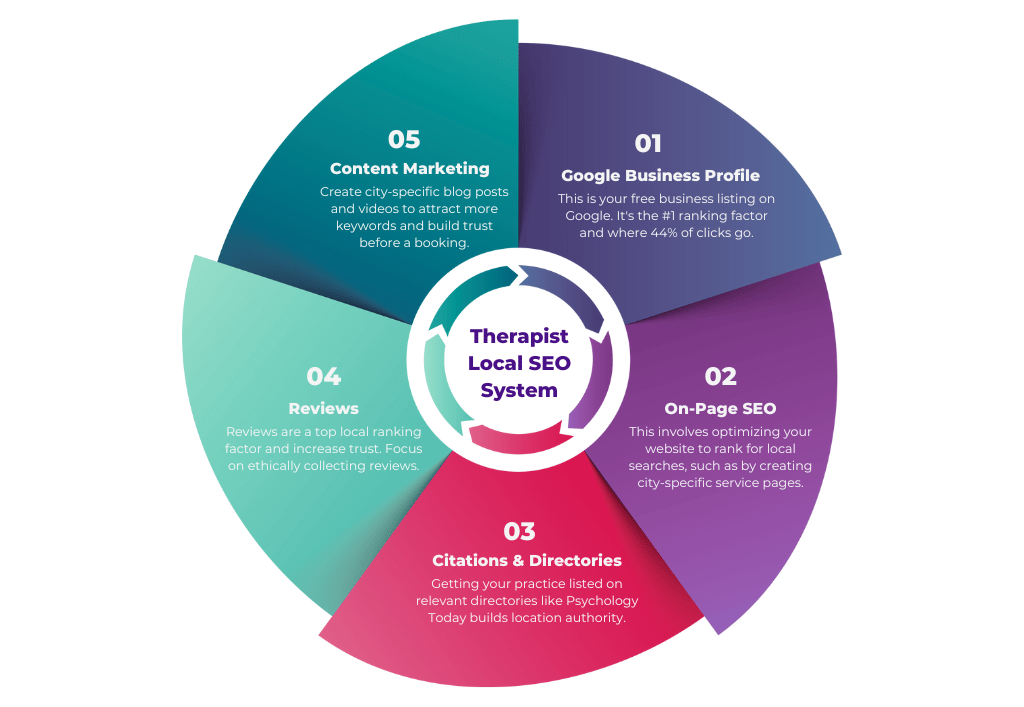
1. Google Business Profile Optimisation
Your free business listing on Google that appears in Maps and local search results.
Why it matters: This is your #1 ranking factor. 44% of clicks go to the Map Pack (top 3 results).
Key elements:
Complete profile (every field filled out)
Verified location (physical address)
Service listings with city modifiers ("Anxiety Therapy Toronto")
Professional photos (headshot + office)
10-20+ reviews
It may take you some time to see results if you do it correctly and you check my guide on How to Set Up a Google Business Profile for Therapists in Canada
2. On-Page Website SEO
Optimizing your website pages to rank for local therapy searches is really important.
Why it matters: Your website supports your GBP and captures clicks from organic search results below the Map Pack.
Key tactics:
Create city-specific service pages ("Anxiety Therapy in Toronto" as separate page)
Optimize title tags with city + service keywords
Add location schema markup (tells Google your location)
Ensure NAP consistency (Name, Address, Phone identical everywhere)
Include clear fee/insurance information on every service page
You need a Homepage, About, and Contact page to establish legitimacy and build trust. I recommend you to Create 3–5 dedicated Service pages (e.g., "Anxiety," "Couples") these are the specific pages that will actually rank on Google.
3. Local Citations & Directory Listings
Getting your practice listed on relevant therapy directories and local business sites is good way to create online presence.
Why it matters: Citations build location authority and provide referral sources beyond Google.
Recommended listings:
Google Business Profile
Psychology Today (industry standard, $30-40/month)
Canadian Counselling Association directory (free if member)
4. Reviews(Strictly Ethical for Canada)
Ethically collecting client reviews while staying compliant with professional codes.
Unlike US therapists or regular businesses, Canadian regulations (like the CRPO) define "soliciting" testimonials from clients as professional misconduct. You cannot ask a client to write a Google Review, even after therapy ends.
The Rules (In Plain Language)
Do not solicit client reviews
You cannot ask current or former clients to leave testimonials or reviews (Google, Facebook, website, etc.). Even a “totally optional” email or survey inviting a public review can be seen as pressure because of the power imbalance in the therapeutic relationship.
Passive is allowed, but hands-off
Clients may, on their own, choose to leave a review on a third‑party platform like Google or Facebook. The key is:You did not ask for it
You did not suggest it
You did not incentivize it (no discounts, gifts, contests)
Peer and colleague endorsements are okay (with boundaries)
You may ask professional colleagues (supervisors, peers, collaborators) to endorse your work on places like LinkedIn or a directory, provided:They are not your clients
Their endorsement is genuine and not incentivized
There is no hidden financial conflict of interest (for example, a referral partner who benefits directly from sending you clients)
Do not reuse client reviews in your own marketing
Even if a client leaves a beautiful Google review, you cannot copy it onto your website, social media graphics, or print materials. Using a client’s words as “advertising” is exactly what most Canadian regulators prohibit.
How to Respond to Client Reviews Safely
If a client does leave a public review on their own, you are allowed to respond, but your reply must never confirm they were your client or reference clinical details. That would violate confidentiality and health‑privacy laws.
Unsafe response:
“I’m so glad I could help with your anxiety, John. Wishing you the best in your recovery.”Ethical, generic response:
“Thank you for your feedback. Our practice is committed to providing professional, respectful care to everyone in our community.”
This kind of neutral language protects confidentiality while still showing that you’re responsive and professional.
Safe, Ethical Review Strategy for Canadian Therapists
Since you cannot ethically or legally “chase” client testimonials, your review strategy needs to focus on social proof that doesn’t involve client pressure:
Prioritize professional/peer reviews
Ask 3–5 colleagues, supervisors, or collaborators to write short, honest endorsements about your professionalism, ethics, and clinical skill.
These can live on:
Your Google Business Profile (as long as it’s clear they are colleagues, not clients)
LinkedIn recommendations
Certain directories that allow professional endorsements
Allow but never invite client reviews
Do not mention reviews in your welcome packets, emails, or discharge process.
If a client spontaneously posts a review, leave it where it is, respond generically if you wish, and do not reuse it as a “testimonial” anywhere else.
Use internal, anonymous feedback for quality only
You can use private, anonymous satisfaction surveys to improve your practice (for example, “On a scale of 1–10, how helpful were sessions?”).
This data must stay internal. You can use trends to improve your service, but you cannot publish individual quotes or identifiable comments as marketing material.
5. Local Content Marketing
Creating helpful blog posts, videos, and city-specific content that attracts local clients.
Why it matters: Content helps you rank for more keywords and builds trust before booking.
What works:
City-specific service pages (your highest ROI content)
Problem-focused blog posts ("Why anxiety gets worse at night")
Short videos (under 3 minutes, your face visible)
Local resource guides ("[City] mental health resources")
1-2 blog posts per month minimum
Which Directories Actually Matter in Canada?
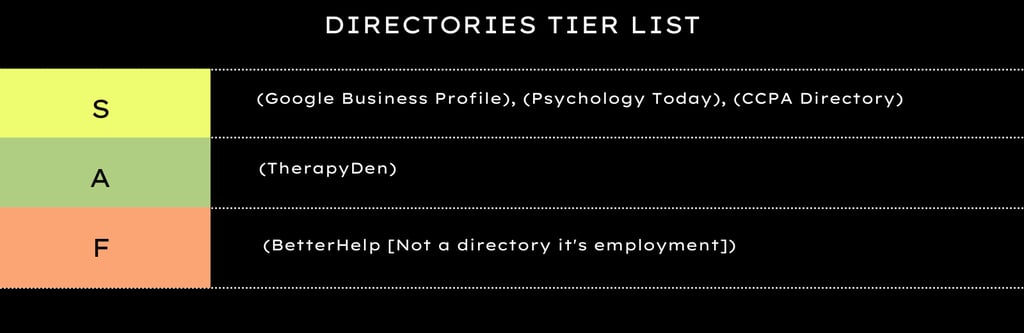
Don't waste money on every platform. Focus your budget where the clients actually are.
Tier 1: Mandatory (Do These First)
Google Business Profile: Free, The #1 source of client leads. If you do nothing else, optimize this.
Psychology Today: ~$35 CAD/mo. The industry standard. Most clients look here first. Crucial if you accept insurance; slightly less effective for cash-pay only.
CCPA Directory: Free (for members). Moderate traffic, but excellent for credibility. If you have your CCC designation, get listed.
Tier 2: The "Maybe" Pile (Test for 3 Months)
TherapyDen: Hit or miss. Use the free version first. Only upgrade if you actually get a lead.
Mental Health Match / Alma: Inconsistent in Canada. Only worth testing if you are in a major city (Toronto/Vancouver).
Tier 3: Avoid (Waste of Money)
Generic Aggregators: These often just scrape data from other sites. They rarely bring real clients.
BetterHelp: This is not a directory; it is a contractor job. You get paid significantly less (~$30k-$70k/yr) and own zero client relationships. Avoid if building a private practice.
The Hidden Gem: Local Referral Lists
Often outperforms paid directories. Contact these free local sources:
Local non-profit mental health resource lists
Community center counselor referral boards
Doctor's office referral lists (ask your local GPs)
University/college student services directories
EAP (Employee Assistance Program) provider networks
Content Strategy That Actually Gets You Clients
Writing generic "What is therapy?" articles is a waste of time. Wikipedia already ranks #1 for that.
To get local clients who are ready to book, you need a strategy that targets their specific problems and their location.
1. The "City + Service" Page Formula
Most therapists just have one page called "Services." This is a mistake. To rank on Google, you need specific pages that match exactly what clients type into the search bar and services you offer.
Do This Instead:
Create a separate page for every major service you offer, paired with your city name.
Instead of just "Anxiety Treatment," create a page titled "Anxiety Therapy in Hamilton"
Instead of just "Couples Counseling," create a page titled "Couples Counseling in Vancouver."
And so on for others,
Why this works:
It matches the search: Clients rarely search for just "therapy." They search for "trauma therapy in [City]."
It pre-qualifies clients: People landing on these pages already know what they want and where they are. They are ready to book.
What to put on these pages:
Headline: The exact service + city name.
The Problem: An empathetic intro that describes how they are feeling right now.
The Solution: How you specifically help with this issue.
The Logistics: Your fees, insurance info, and a clear button to "Book a Free Consultation."
You don't need to write from scratch. If you have a general services page, you can break it up into 3–4 specific city pages.
2. "Problem-Focused" Blogs (With a Local Twist)
Stop writing clinical definitions like "What is CBT?" or "The History of Psychoanalysis." Your clients don't care about the history, they care about their pain.
Write about the problem they are Googling.
Bad: "Benefits of Cognitive Behavioral Therapy."
Good: "Why Anxiety Gets Worse at Night (And 3 Ways to Calm Down)."
Good: "How to Tell if Your Relationship Needs Counseling."
How to make it "Local SEO" (The Secret Sauce): Google loves local context. Sprinkle your city into the intro or examples naturally.
Example: "Living in a fast-paced city like Toronto can make high-functioning anxiety feel normal. But if you can't sleep..."
The Link: Inside the blog post, always link to your specific service page. (e.g., "If this sounds like you, learn more about my Anxiety Therapy in Toronto.")
3. Short Videos
Video builds trust faster than text ever will. If a client sees your face and hears your voice, they feel like they already know you.
Record simple, 30–90 second videos answering common questions. You don't need a fancy camera; your phone is fine. eg- "One grounding exercise for panic attacks." or "What actually happens in the first session?"
Don't just leave them on Instagram. Embed them on your website.
Put your "Welcome" video on the Homepage.
Put your "Anxiety" video on your "Anxiety Therapy in Toronto" page.
When people watch a video, they stay on your website longer. Google sees people spending time on your site and assumes it must be high-quality, which pushes your rankings up and now google also ranks your video in google search.
What Usually Wastes Your Time
Inconsistent Blogging: Posting once and then disappearing for 6 months tells Google your site is dead.
Stock Photos: Using generic "people laughing at salad" stock photos builds zero trust. Use real photos of yourself and your office.
Academic Essays: If your writing sounds like a textbook, clients will tune out. Write like a human.
The Minimum Effective Plan
You don't need to be a content machine. Just do this:
Once per Quarter: Create or update 1–2 City-Specific Service Pages.
Once per Month: Write 1 Problem-Focused Blog Post (and link it to a service page).
Once per Month: Record 1 Short Video and put it on your website.
Check my post on Blotato ai tool you can use to repurpose your content fast.
30-Day Quick Win Local SEO Plan
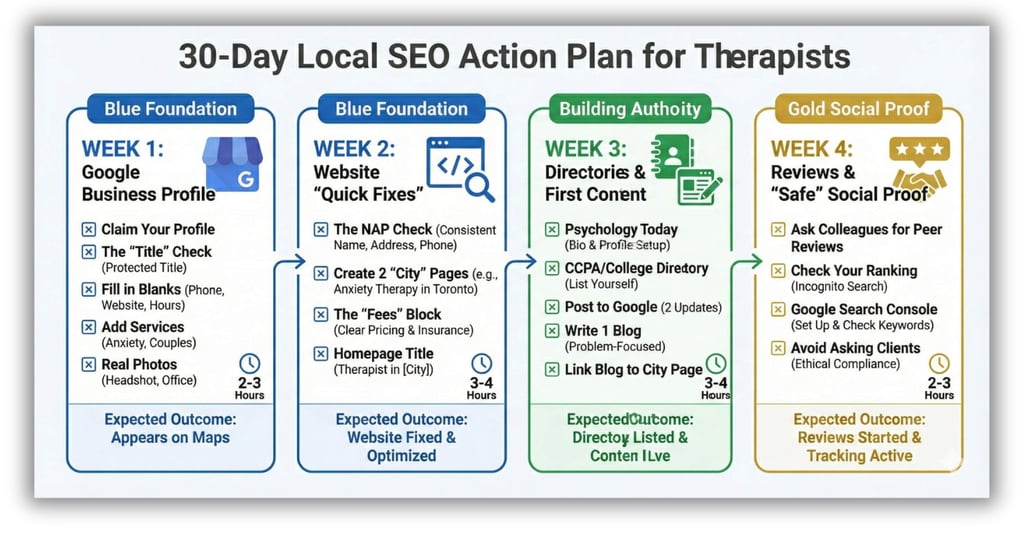
If you are starting from zero, don't try to do everything at once. This is a realistic Month 1 plan that builds a foundation without burning you out.
Week 1: The Google Business Profile
This is the single most important thing you will do. If you do nothing else, do this.
Claim Your Profile: Go to Google Maps, find your business (or create it), and verify you own it.
The "Title" Check: Ensure your business name matches your license exactly. (Remember the "Protected Title" rule don't use "Psychotherapist" if you are a "Counsellor").
Fill in the Blanks: Add your phone, website, and hours.
Add Services: Manually add your services. Don't just put "Therapy." Add "Anxiety Therapy," "Couples Counselling," and "Depression Treatment."
Real Photos: Upload 3–5 photos.
Good: A clear headshot of you smiling; the outside of your building; your waiting room.
Bad: Stock photos of people stacking rocks.
Week 2: Website "Quick Fixes"
You don't need a new website. You just need to fix the one you have so Google understands it.
The NAP Check: Make sure your Name, Address, and Phone number on your website match your Google Profile exactly.
Create 2 "City" Pages: Write (or rename) two service pages to include your city.
Old: "Anxiety Services"
New: "Anxiety Therapy in [Your City]"
The "Fees" Block: Add a clear "Fees & Insurance" section to every service page. (Google hates when users bounce back because they can't find prices).
Homepage Title: Hover over your browser tab. Does it just say "Home"? Change it to: "Therapist in [City] – [Your Name] | Anxiety & Couples Therapy"
Week 3: Directories & First Content
Now we build some "authority" so Google trusts you.
Psychology Today: Set up your profile. It costs ~$35/month, but it usually pays for itself with one client.
Tip: Write your bio in the first person ("I help you..."), not the third person ("Jane helps you...").
The CCPA/College Directory: If you are a member of the CCPA or a provincial college, make sure you are listed in their public directory. This is a powerful "trust signal" for Google.
Post to Google: Go to your Google Business Profile and create 2 "Updates."
Topic: A quick tip (e.g., "3 ways to handle Sunday Scaries").
Why: This tells Google your business is active and alive.
Write 1 Blog: Write one "Problem-Focused" article (as discussed in the Content Strategy) and link it to your new City Page.
Week 4: Reviews & "Safe" Social Proof
Warning for Canadian Therapists: Most Colleges (like the CRPO in Ontario) strictly forbid asking current or past clients for testimonials. It is considered an abuse of power. Do not email your clients asking for reviews unless you are 100% sure your College allows it.
Conclusion
Let’s be honest: you didn’t get into this field to stress over algorithms, keywords, or "conversion rates."
You did it to help people. But the reality of private practice is that people can’t heal if they can’t find you. The good news is that you don’t need a massive budget or a marketing degree to fill your caseload; you just need to be visible.
The therapists who succeed aren't the ones trying to "trick" Google or those who have discovered some secret tactic.
They are simply the ones who cover the fundamentals: claiming their space on Google Maps so they exist, writing clear pages about their city so locals can find them, and building trust with honest reviews so clients feel safe.
If you are feeling overwhelmed and only have the energy to do one thing this week, forget the blog posts and fancy videos.
Just spend one hour fixing your Google Business Profile. Upload a warm photo of yourself, list your specific services, and make sure your hours are accurate.
That single hour will likely do more for your practice than a month of posting on Instagram. Marketing isn't about vanity; it's about accessibility.
Right now, there is someone in your city sitting up at 11 PM, feeling anxious and typing "therapist near me" into their phone.
Your job isn't to be the best marketer in the world; your job is just to make sure that when that person searches, your door is open. Start small, stay consistent, and the clients will find you.
FAQ
Q1: Does Local SEO work differently in small towns vs. big cities?
A) Yes and small towns have a huge advantage.
The Big City Problem: In Toronto or Vancouver, you are competing with hundreds of clinics and massive teletherapy companies. Ranking requires a big budget and months of work.
Pros: In a small town, competition is low. You might be the only therapist optimizing for "Anxiety Therapy in [Your Town]."
Easier Rankings: You can often hit the #1 spot with just a good website and a Google Business Profile.
Broader Reach: In rural areas, you can rank for neighboring towns (e.g., 20km away) because people are used to driving for services.
Community Power: Sponsoring one local hockey team or charity event gets you a powerful "local backlink" that big city therapists can't get.
Cons: Search volume is lower. You won't get 100 clicks a day, but the 10 clicks you do get are usually local people ready to book.
Q3: Do I really need a website, or is a Google Profile enough?
A) Technically no, but practically yes. You can appear on Maps with just a Google Profile, but having a website makes you look like a legitimate medical professional, not a hobbyist.
The Minimum You Need: You don't need a fancy 20-page site. You just need 5 simple pages:
Home (Who you are).
About (Your credentials).
Services (What you treat).
Fees (How much it costs).
Contact (How to book).
Q4: Should I hire an agency or do this myself?
A) Do it yourself if:
You are just starting and have a low budget.
You can spare 3–4 hours for the initial setup.
You are comfortable using basic tech (like email and social media).
Hire an agency if:
You are fully booked and have zero free time.
You have tried for 3 months and seen no results.
You can afford $500–$1,500/month.
Warning: Many "SEO Agencies for Therapists" are scams. They charge you $500/month just to update your Google Profile something you can do yourself in 5 minutes. Always ask exactly what they will do every month.
Q5: Can I actually rank if there are 50+ other therapists in my city?
A) Yes. Most of your competitors are lazy. They have incomplete profiles, no photos, and generic descriptions like "I help everyone."
Be Specific: Don't be another "General Counsellor." Be the "Anxiety Specialist for Healthcare Workers." Google loves specialists.
Use City Pages: While they have one generic "Services" page, you will have "Anxiety Therapy in [City Name]." That specific detail wins the ranking war.
Q6: Do I really need to blog every week?
A) No. Please don't burn yourself out. You do not need a blog to rank your main website.
Essential: Your City-Specific Service Pages (e.g., "Trauma Therapy in Ottawa"). These are the pages that actually get you clients. Focus on these first.
Optional: Blog posts. These are great for catching people who are just asking questions (e.g., "Why do I feel sad?"), but they are not required to fill your practice.
The "Good Enough" Plan: If you want to blog, just write one high-quality post a month. That is plenty.
Resources
Get our weekly newsletter:
Quick Links
© 2025 TechieNexum. All Rights Reserved.